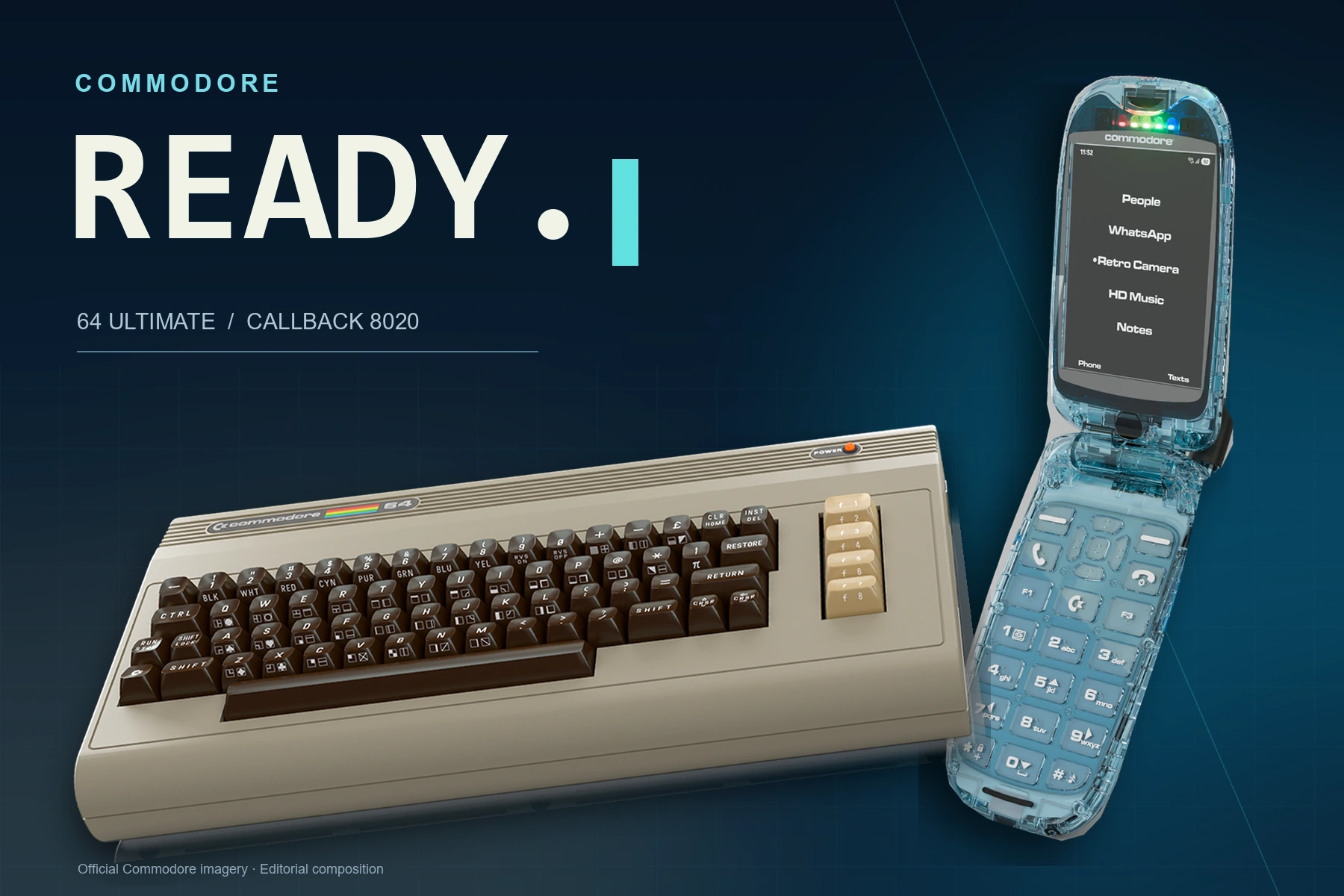
The historic brand is back in the hands of a group rooted in the classic-computing community. We explore the acquisition, the people, the relationship with Amiga and a compelling family of FPGA computers. Then comes the Callback 8020, a flip phone aiming to restore some of the pleasure of owning a device with a personality.
A cartridge in the slot, a nine-pin joystick, a cursor waiting after READY. For anyone who spends time with old computers, these are useful measures of a Commodore comeback. A name on a case can spark curiosity; a machine that invites you to load, program and experiment can sustain it for years. The new Commodore International is building its credibility in precisely this space, where nostalgia meets tools that still have something to offer.
From the community to the brand acquisition
The story begins within the community. Peri Fractic, known to the Retro Recipes audience as Christian Simpson, approached the brand’s owners alongside Leo Nigro and Sean Donohue. Nigro had created the C64X and Commodore OS; Donohue had worked on the computer’s revival through My Retro Computer. A C64X review published by Peri in 2024 helped bring them into contact. Discussions moved through collaboration, licensing and eventually buying the company, as Peri later explained to The Game Business. [1] [2]
The Let’s Buy Commodore video series brought the initiative into public view in June 2025. A preliminary agreement was followed by the decisive step on July 31, 2025, when the group acquired all of Commodore Corporation B.V., the Dutch company holding the trademarks, from its previous owners. The deal covered the 47 surviving original trademarks, with registrations dating back as far as 1983. The closing announcement credited private investors and the support generated by the Ultimate’s launch with helping fund the purchase. Peri had described the price as a sum in the low seven figures. The public sources reviewed do not identify the final detailed price or a complete list of individual sellers. [3] [4] [5]
The current corporate structure is clearly defined. Commodore International Corporation is a Delaware public benefit corporation; its wholly owned Dutch subsidiary holds the trademarks and licenses their use to the parent company. The continuity therefore concerns ownership of the acquired trademark portfolio. The manufacturing and commercial organization has been built for this revival. The fans’ involvement also deserves an accurate description: buying a computer supports the business, while the commemorative certificate supplied with a Founders Edition remains a collectible. [6] [7]
Commodore and Amiga: trademarks, rights and agreements
The Amiga connection calls for an equally important distinction. Following Escom’s liquidation, the Commodore and C= trademarks passed to Tulip and followed a different path from much of the other historical property. On August 4, 2026, Amiga Corporation announced an agreement recognizing the new Commodore’s trademark rights and licensing CBM eight-bit software and documentation to it. The historical copyrights and Amiga trademarks remain with Amiga Corporation. This agreement gives the revival a clearer and more practical foundation; any eventual reunion with Amiga would require a further arrangement. [8]
There is also the dispute with the separate Italian company Commodore Industries. International announced legal action on December 12, 2025, challenging that company’s registrations; Industries had asserted the validity of its Italian and European trademarks. These are the respective parties’ positions. The sources examined document the Dutch acquisition and the litigation, without providing a final judgment that would establish the dispute as settled. Assessing the new C= requires keeping these matters separate and treating a company’s slogan as distinct from a court ruling. [9] [10]
The people and the classic-computing community
The team brings together management, design and advisory expertise. Peri leads the business and its products; Nigro and Donohue are co-founders. Marc Bilodeau oversees technology, Emilie McGinley operations, and Jim Squires strategy and software. Jon Burton heads product, Cem Tezcan handles design, and Thomas Middleditch leads the creative side. Advisors include Albert Charpentier, Bil Herd and Dave Haynie; Jeri Ellsworth, RJ Mical and Leonard Tramiel are involved too. The veterans’ presence is particularly interesting for the technical and cultural knowledge they can contribute to the projects. [11]
John Errico handled legal aspects of the acquisition. On the manufacturing side, Jake Young works with the factories; Larry Hryb, familiar to Xbox fans as Major Nelson, has also been announced as a community advisor. These are different responsibilities, and the distinction helps explain the new Commodore: the project brings together an operating team, specialist collaborations and advisory figures. [11] [12] [13] [14]
The relationship with the people who kept the platform alive takes commercial form in the licensing program. A brand license costs 6.4% of net sales; promotion through the marketplace carries a separate 6.4% commission on sales generated, reaching 12.8% when both options are combined. It is an interesting attempt to give small producers greater visibility and routes to market. Its quality will be measured by how easy collaboration becomes and how well it respects the independence of a scene already capable of producing excellent hardware and software. [15]
Commodore 64 Ultimate: rebuilding the C64 in FPGA
The product that makes the strongest case for the revival is the Commodore 64 Ultimate. It builds on the work of Gideon Zweijtzer, creator of the Ultimate 64 and a system architect involved in developing the C64U. That lineage matters enormously: the new computer draws on years of work recreating the machine and its peripherals. Commodore packages that experience as a complete product, with a keyboard, case, power supply and documentation. [16] [17]
The FPGA implements the behavior of the C64’s circuits through programmable logic. The CPU, video circuitry and peripherals are recreated in hardware. Accuracy depends on the design and firmware, so the term FPGA describes a technical approach without automatically guaranteeing every detail of the original machine’s behavior. Commodore claims compatibility above 99.9%, an ambitious figure that should be read as a manufacturer’s claim. The Ultimate documentation also lists cartridge types that have yet to be implemented. For a rare peripheral or a particular piece of software, checking the specific combination makes sense. [18] [19] [20]
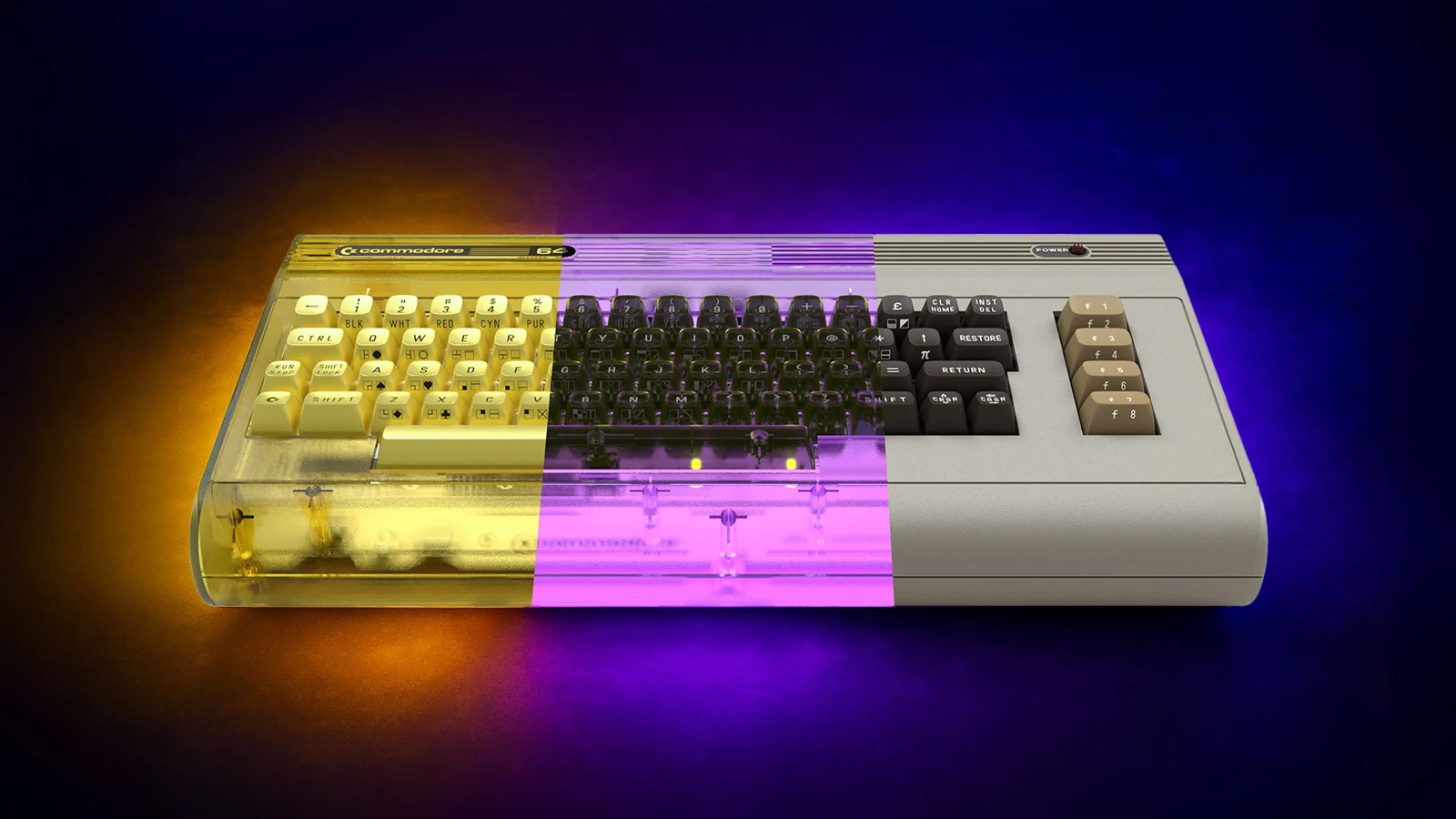
The standard platform uses an AMD/Xilinx Artix-7, 128 MB of DDR2 and 16 MB of NOR flash. Memory is allocated to the system, REU and GeoRAM functions, as well as a RAM disk. The regular C64 environment retains its own address space: the additional memory serves the Ultimate’s expansions and functions, and is available to software designed to use it. The same distinction applies to 1080p HDMI at 50/60 Hz. The video output adapts to modern displays; the games retain the resolutions, palette and image construction associated with the VIC-II. [19]
Turbo, memory and audio: extended possibilities
The current website advertises Turbo at up to 64 times the original speed; the Elite II platform documentation specifies a maximum of 64 MHz. Its benefits are particularly relevant to calculations and CPU-limited routines. A software 3D engine can gain substantially; a game built around tight timing may need the original speed. The VIC retains priority for the accesses it needs, and the external bus keeps its own constraints. The multiplier therefore describes a configuration option whose benefits depend on the program. [19] [21]
These two approaches are especially productive for developers. You can work within the classic specification, with the limits that gave the C64 scene its identity, or build experiments for the expanded capabilities. The Made for U(ltimate) program, announced in August 2026, encourages the use of Turbo, additional memory and enhanced audio. For RetroMind, the distinction remains essential: a result achieved on an accelerated configuration should be presented with that configuration identified. Both paths can produce interesting software. [22]
Audio provides eight SID implementations in the FPGA, for a total of 24 voices and eight independent filters. Compositions need to be written to take advantage of them. Two physical 6581 or 8580 SID chips can also be installed, with automatic voltage and filter detection. The integrated cores already produce sound, leaving original chips as an option for enthusiasts. This is an appealing choice for anyone who wants to compare SID revisions or revisit a soundtrack using their own chip. [23] [24] [19]
Connections, keyboard and storage
The connections restore the pleasure of a complete desktop setup. Alongside HDMI is analog video through an eight-pin DIN socket, with composite, S-Video and RGB modes; audio has a 3.5 mm stereo output, optical S/PDIF and a SID-TAP connection. The cartridge slot, Datasette connector and serial IEC connection remain, together with two DB-9 ports for joysticks and paddles. The user port requires a separate adapter connected internally. The onboard speaker can reproduce drive noises; the multifunction switch handles power, menus, reset and freeze. [24] [18] [25]
One clarification helps when reading the marketing specifications. Two USB-A ports are accessible at the rear; a third is internal, as is the microSD slot. The internal connector with a USB-C form factor has a dedicated keyboard function. The C64U takes power from a 12 V supply with a barrel connector. The audio jack also deserves attention: the manual describes it as a line output, suitable for a sound system or powered speakers. [26]
The 66-key mechanical keyboard retains the Commodore layout and uses 55-gram Gateron Pro 3.0 switches, with full rollover and macros. The illuminated editions add 154 RGB LEDs. These details matter beyond the specification sheet: the keyboard shapes the pleasure of writing a small program, fixing a routine or using an application. The Ultimate invites you to stay at the machine after loading that first game. [19]
Storage incorporates Ultimate-II+ functions. Two virtual drives can behave as 1541, 1571 or 1581 units, using the corresponding disk images. CRT cartridges, TAP tapes and PRG programs are supported, alongside fast DMA loading and media formatted as FAT, FAT32 or exFAT. The benefit is practical: you can retain a relationship with original peripherals while using convenient digital archives on the same computer. Loader compatibility still depends on correct drive implementation and timing. [27] [20] [19]
The virtual printer saves pages produced by compatible applications as PNG files, allowing work created in the Commodore environment to move to a modern computer. Modem emulation also lets C64 terminal programs connect to BBSs. These are particularly successful connections between historical practices and contemporary tools: you can return to laying out a document or visiting a text-based bulletin board on the same machine you use for games. [28] [29]
Networking, CommoServe and bundled software
100 Mbps Ethernet and built-in Wi-Fi bring file transfers and network services to the machine. CommoServe lets you find and load software from the C64U menu, reducing the repeated trips to a USB stick prepared on a PC. Firmware 1.1.0 moved searches to Commodore’s server, with content authorized by developers, and introduced USB mouse support and networking improvements. For recording games and demos, there is also C64 Stream, a community project linked from the official website that receives audio and video in OBS over Ethernet. [30] [31] [32]
The box includes the computer, power supply, HDMI cable, spiral-bound manual and a cassette-shaped USB drive. The drive contains over a hundred items across games, demos and collections, along with tools and applications. The selection includes Lykia, Lester and The Way of the Exploding Fist; the demo section features works such as Edge of Disgrace and Comaland. Then there is GEOS, with geoWrite, geoPaint and geoPublish. It is a convincing way to show that the C64 remains a computer for drawing and writing as well as a gaming platform. [7] [33] [34] [35]
Ultimate editions, the C64C and Commodore 77
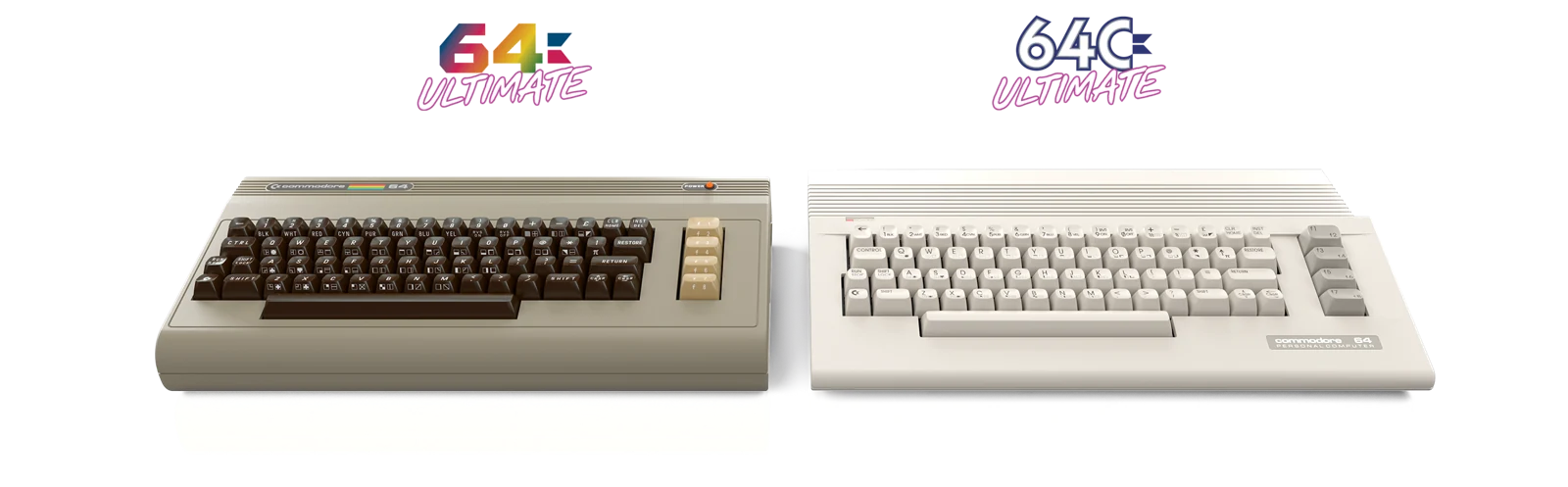
The standard editions differ mainly in appearance and collectible extras. BASIC Beige keeps the most traditional look and omits keyboard and case lighting. Starlight puts transparency and reactive illumination at the center of the design. The breadbin Founders Edition combines an amber case with gold-colored PVD finishes, gold-plated details and commemorative accessories. Choosing Beige preserves the platform’s core capabilities; Starlight and Founders cater to different tastes in how the computer should look and feel on a desk. [7]
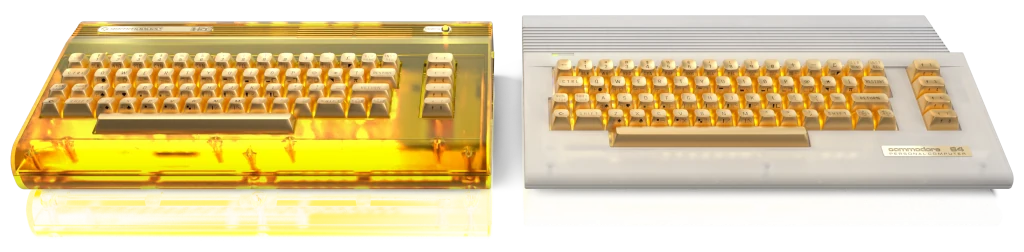
The C64C Ultimate, announced on April 28, 2026, brings back the slim 1986 case with performance identical to the breadbin. To manufacture it, Commodore bought back the original molds from Individual Computers. There is something particularly appealing about recovering the industrial tooling, right down to the characteristic flow marks in the plastic. The C64C also comes in Beige, Starlight and Founders editions; the last combines gold-colored keys with a slightly translucent white case. [36]
| Family | What distinguishes it | Listed price in US dollars |
|---|---|---|
| C64 Ultimate breadbin | Classic case; BASIC Beige, Starlight and Founders editions. | 349.99 to 549.99 in the catalog consulted. |
| C64C Ultimate slimline | 1986 shape and original tooling; the same capabilities as the standard platform. | 299.99 to 499.99 in the catalog consulted. |
| Commodore 77 | Cyberpunk 2077 edition with a larger FPGA and exclusive content. | 377; available to preorder, with release announced for early 2027. |
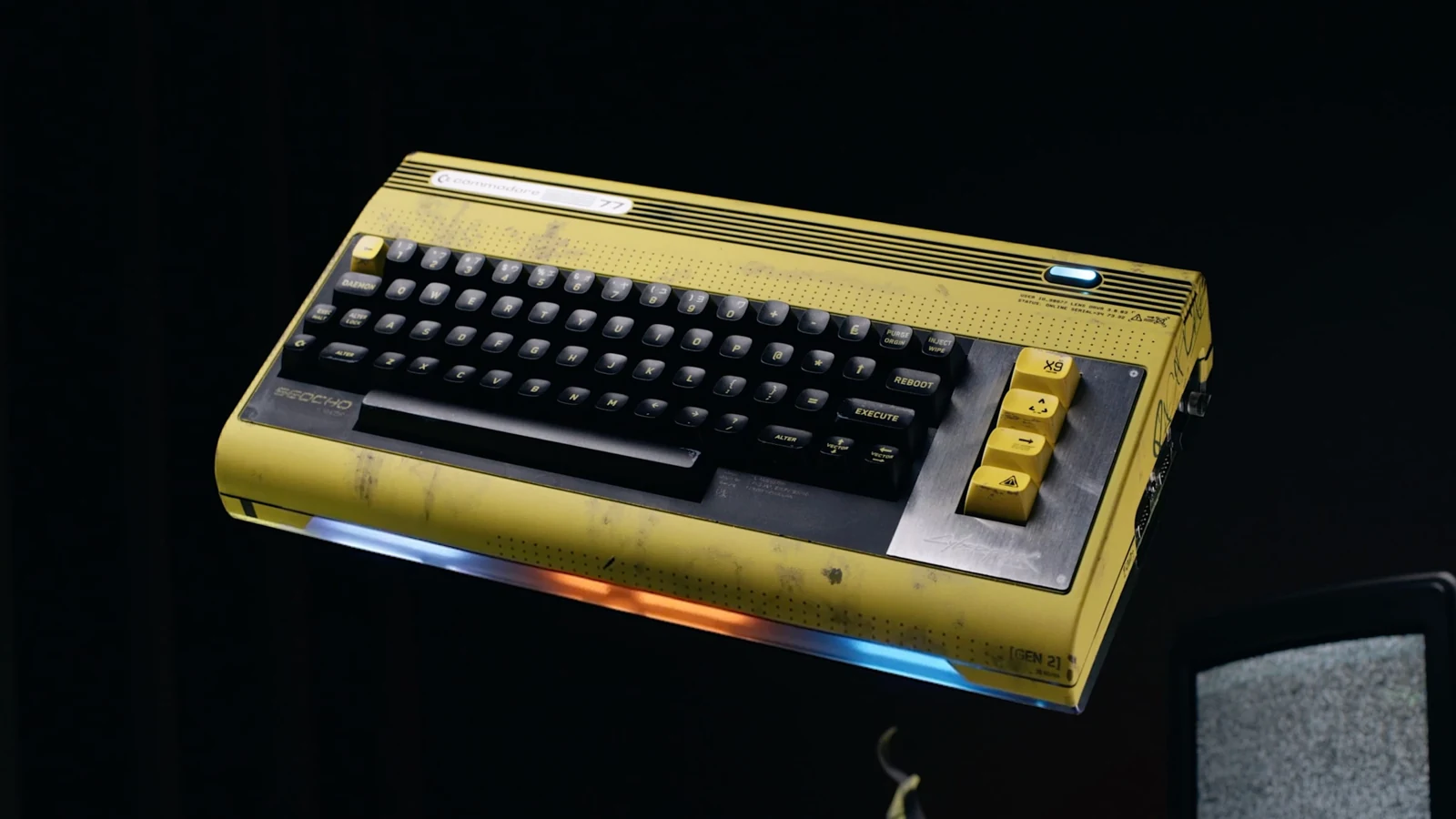
The Commodore 77 variant, developed with CD PROJEKT RED, deserves a closer mention. Its Night City-inspired case houses an Artix XC7A100T, larger than the standard 50T, with a stated target of 77 MHz. It includes an Arise demo featuring music by LukHash on a 2 MB cartridge. The experience belongs to the world of the C64 and the demoscene; the modern game Cyberpunk 2077 supplies the setting and visual identity. The announced performance will need confirmation on the shipping version. [37]
One episode also helps assess the company’s relationship with enthusiasts. In April 2026, Commodore withdrew its plan to prevent the installation of alternative firmware following community objections. The distinction between officially supported firmware and third-party modifications remains. Its willingness to change that decision is a welcome sign for a platform that thrives on experimentation. The Ultimate makes its case by offering a usable, expandable computer that remains interesting after the initial excitement of unboxing has passed. [38]
Callback 8020: a phone with a distinct identity
The Callback 8020 takes that search for personality into different territory. It is a flip phone designed to preserve the useful functions of connected life and reduce the opportunities for constant checking. For an audience raised on physical keyboards and devices recognizable by touch, the idea has an immediate appeal. Closing it brings an interaction to an end. The promise becomes interesting when that gesture comes with messaging, navigation and a capable multimedia specification. [39]
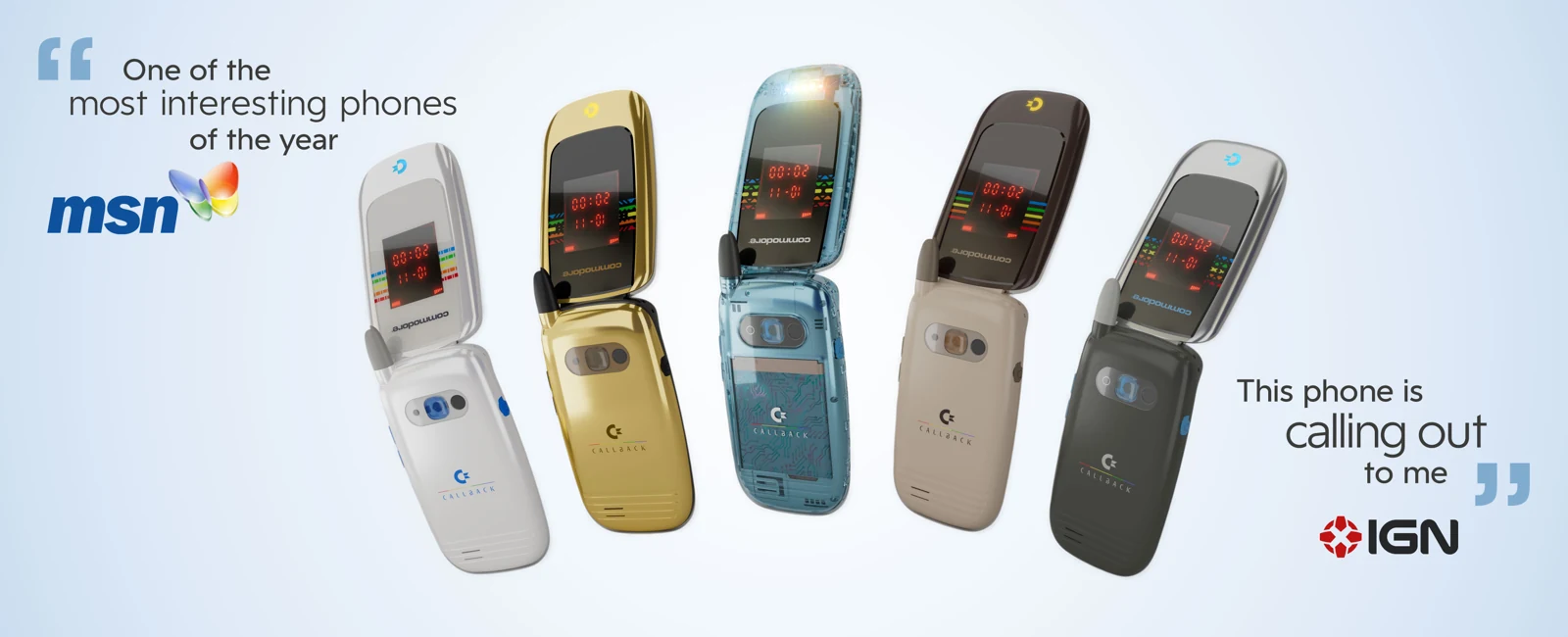
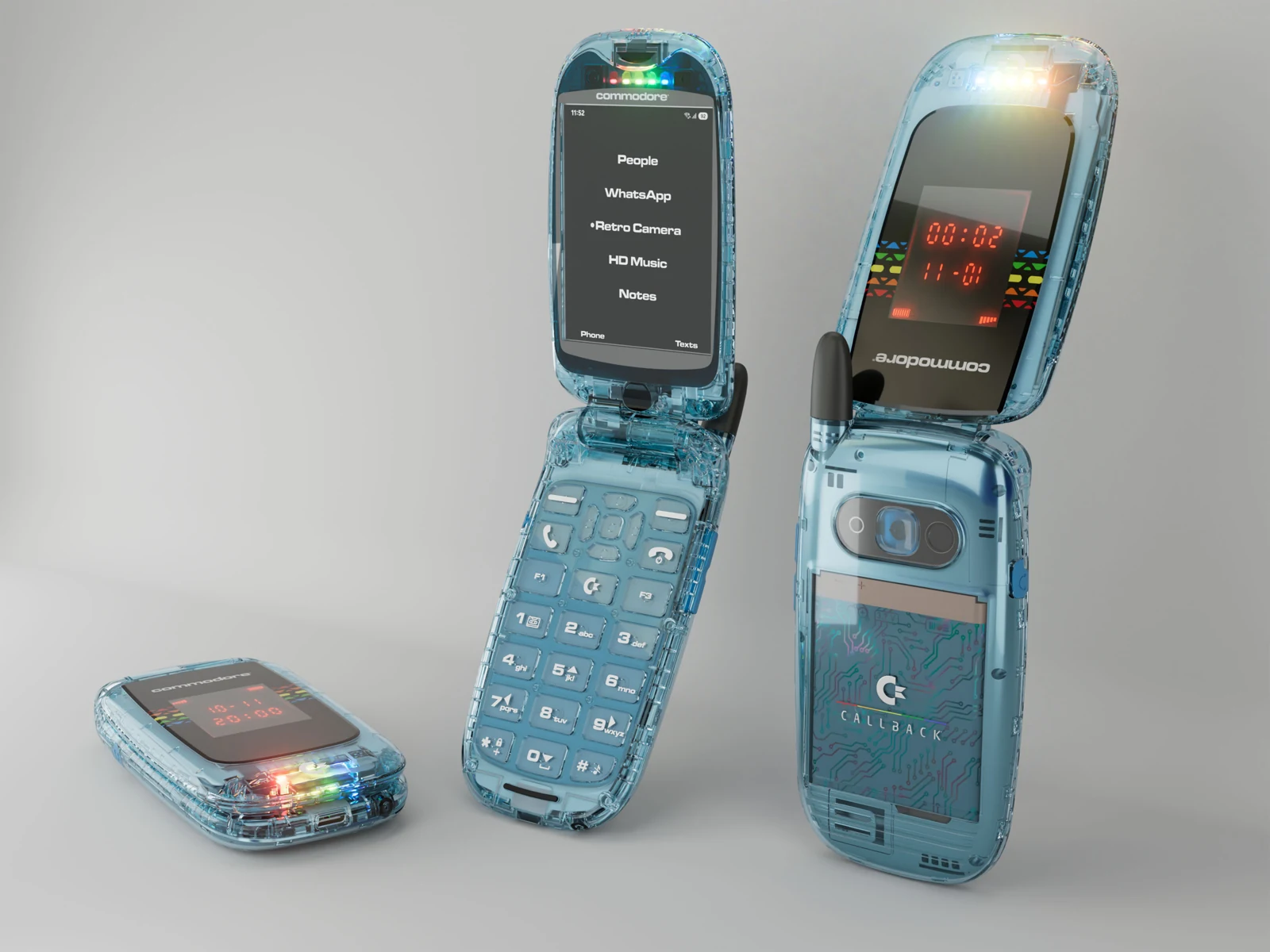
The operating system is a customized version of Sailfish OS, developed with Jolla and rooted in the work of Nokia and MeeGo. Compatible Android applications run through AppSupport. Commodore also describes a custom circuit board and dedicated molds, alongside contributions from flip-phone specialists. The collaboration brings software and manufacturing expertise together around a specific experience. It is a sensible approach for a company that has to choose where to concentrate its design work. [40] [41] [42]
The stated specification includes a MediaTek Helio G81 processor, 4 GB of RAM and 64 GB of storage, with microSD expansion. Cellular connectivity reaches 4G with VoLTE, alongside Wi-Fi, hotspot support and Bluetooth; two physical SIM slots are planned, with no eSIM. The replaceable battery has been updated to 1,850 mAh. The internal display is touch-sensitive, with a resolution of 480 × 640, and the physical keypad can be supplemented by touch whenever needed. The stated IP44 rating covers splashes. These choices should be considered in relation to the everyday tasks the phone is intended to handle. [43] [44]
The external display recalls Commodore’s calculators and shows essential information with the phone closed. Five Dome LEDs use color to communicate the notifications selected by the user; a physical privacy control sits on the back. Interchangeable Snapback covers bring back another enjoyable habit from earlier phones. Here, the design serves a practical purpose: making the device’s status recognizable and leaving the owner to decide how often to open it. [40] [45] [46]
A 48-megapixel Sony camera with autofocus and flash, a front camera for video calls, and audio components from ESS and Cirrus Logic give substance to its multimedia ambitions. A 3.5 mm jack, FM radio and SID file playback add a character particularly suited to the brand. The camera’s quality will have to be judged by the images it produces, while the audio will depend on the entire playback chain. Interesting components provide a promising foundation; the final experience needs well-finished software. [45] [42] [46]
The connection with Commodore’s history extends beyond beige plastic. Selected Commodore games, BASIC and tools for listening to SID music have been announced. The C64U Remote app controls the Ultimate over a local network, including loading, lighting and Turbo settings. For owners of the computer, this connection makes the phone a useful accessory for the same setup. It is a modest ecosystem idea with an easily understood purpose, requiring little upheaval in the user’s habits. [44]
Allowed applications and practical limits
The most distinctive element remains the software it allows. Browsers and social networks are blocked at the system level through the mechanism Commodore calls Quarterback. The Commostore catalog offers selected applications; the project also allows for installing compatible APKs from outside the catalog, within those restrictions. WhatsApp, Signal and Telegram are among the planned communication functions. Email needs a clarification: the current FAQ allows it to be added, while keeping it outside the initial experience. Web screens required for certain authentication processes can open in a limited form. [47] [45]
This approach offers a clear advantage for someone seeking a firm boundary. An application rejected by the system is harder to restore during a distracted moment than an icon voluntarily deleted. At the same time, buyers need to be comfortable with that choice. Anyone who considers unrestricted browsing or installing any application essential will feel those limits more keenly than someone seeking a phone devoted to contacts, travel and music. The Callback proposes a particular relationship with a device, and its success depends on finding the right audience.
The practical omissions deserve attention before buying. There is no NFC or contactless payment through Google Wallet; Android Auto is currently excluded. The advertised figure of 99% Android app compatibility is an estimate associated with AppSupport, with exceptions involving Google services, certification and Play Integrity checks. Some banking applications may therefore have limitations, and an application launching says little about whether every operation will complete. Anyone who uses a phone for payments, authentication and travel should check the particular services they rely on every day. [45] [43]
For typing, a numeric keypad with predictive input can be pleasant for short messages. Longer conversations, forms and applications designed for large screens require more adjustment. The removable battery is a practical advantage for the product’s useful life; real-world battery life remains to be measured, as Commodore says optimization is still under way. Continued software updates will also be crucial: a phone operates within services that change, and keeping them working requires sustained effort. [43]
Pricing, availability and prospects
The BASIC Beige, ProtoPET White and SX Silver finishes evoke three different aspects of Commodore’s history; Starlight adds translucent blue. The announced starting price for these four versions is US$399. The Founders Edition reaches US$640, with a gold-colored finish, a gold-plated C= key and collectible extras. The price-reduction announcement also explains the use of recovered and tested memory in the base configuration, with a premium option announced. This is a detail to check in the configuration purchased, alongside the accessories actually included. [48] [49]
As of November 4, 2026, the Callback remains available to preorder. In its October 22 update, the company describes production-line trials in Shenzhen and targets the first batches arriving by late November; the configurator shows later windows for more recent orders. Dates therefore need to be checked against the relevant batch. The prospects are interesting, while battery life, software polish and everyday compatibility will require evidence from shipping devices. For buyers in Italy, the dollar prices also need to be considered alongside VAT and the actual checkout terms. [13] [43] [6]
The value of using Commodore again
Our assessment of the new Commodore is very favorable. The Ultimate offers a concrete reason to return to BASIC, preserve a collection and follow what the scene is creating today. The Callback adds a more personal proposition, with the potential to interest people who know the C64 mainly through its logo. The chosen direction brings together a recognizable heritage, real expertise and products with an understandable purpose. For a brand so deeply loved, making people want to use a machine again is already a meaningful achievement.
We particularly like the idea that a new generation might encounter Commodore through a newly built device, open the manual and wonder what to do with it. That is the same curiosity that has kept the platform alive for decades. READY. still works because it leaves the next move to the user.
Sources
- The Game Business — The origins of the Commodore acquisition
- Commodore OS — The project and its history
- Commodore — Frequently asked questions
- Old School Gamer Magazine — Acquisition of the brand and 47 trademarks
- Tom’s Hardware — Commodore acquisition and new leadership
- Commodore — Terms and conditions
- Commodore — C64 Ultimate configurations and package contents
- Amiga Corporation — August 4, 2026 update
- Commodore International — Statement on the trademark dispute
- Commodore Industries — Italian statement, July 2025 (PDF)
- Commodore — The team
- Commodore — Meetings with Amiga Corporation
- Commodore — Factory update: Callback 8020, C64C and TAC-2
- Commodore — Larry Hryb joins as a community advisor
- Commodore — Licensing program
- Commodore — The proposed FPGA firmware protection
- Ultimate64 — The project and Gideon Zweijtzer
- Ultimate64 — Ultimate 64 Elite MK2
- Commodore — Ultimate platform specifications
- Ultimate Documentation — Cartridge support
- Ultimate Documentation — Turbo mode
- Commodore — Made for U(ltimate)
- Ultimate Documentation — Multi SID configuration
- Ultimate Documentation — Ultimate 64 manual
- Commodore — Downloads and documentation
- Commodore — C64U User Guide, first edition (PDF)
- Ultimate Documentation — Virtual disk drives
- Ultimate Documentation — Virtual printer
- Ultimate Documentation — Modem
- Commodore — CommoServe
- Commodore — Firmware 1.1.0 release notes
- GitHub — Chris Gleissner’s c64stream project
- Commodore Press Play — Games
- Commodore Press Play — Demos
- Commodore Press Play — GEOS
- Commodore — C64C Ultimate announcement
- Commodore — Commodore 77 and Cyberpunk 2077 announcement
- Commodore — Revised firmware protection policy
- Commodore — Why a flip phone
- Commodore — Callback announcement
- Jolla — AppSupport
- Commodore — Callback design and components
- Commodore — Callback 8020 product page and configurator
- Commodore — Callback applications
- Commodore — Callback overview and frequently asked questions
- Commodore — Callback 8020 updates
- Commodore — Quarterback, permitted applications and Sailfish
- Commodore — Transparent Callback and pricing update
- Commodore — Official store